
Ultra-Fine Eyeliner Tips: 0.02 mm vs Standard Felt Tips for Private Label Products
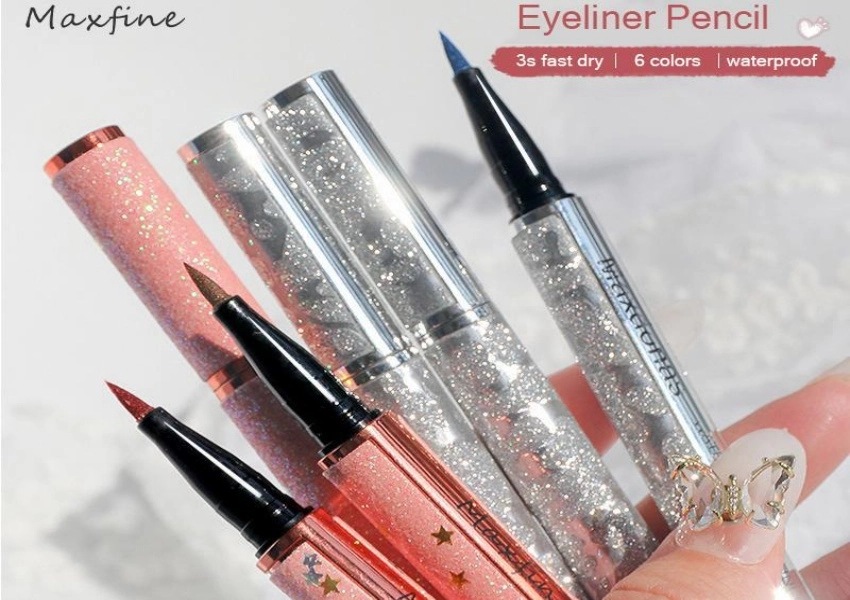
A 0.02 mm eyeliner tip sounds precise, but the number alone does not tell a buyer whether the pen will draw a clean line all day. Ink has to travel from the reservoir through the feed and into the tip at a controlled rate. The tip must touch the skin without splitting, dragging, or releasing a heavy first drop. A standard felt tip may look less fine on paper, yet it can offer a different balance of flow, pressure tolerance, and handling speed. The comparison belongs in a finished pen, not in a specification sheet alone.
For a private label product, the useful decision is not which number appears smaller. It is which tip and feed combination matches the intended customer: a precision user drawing a thin lash line, a beginner who needs a little pressure forgiveness, or a retail customer who expects waterproof eyeliner to set quickly but still remove without excessive rubbing. The same pen also needs to remain usable after storage, transport, and repeated opening.
The liquid eyeliner pens category is a useful starting point when the buyer is comparing brush-tip, felt-tip, gel, and double-ended directions. The category route helps frame the product family; the proposed tip and formula still need SKU-level approval.
What 0.02 Mm Actually Tells A Buyer
Tip diameter is only one part of line control. The visible line depends on tip shape, fibers or felt structure, ink viscosity, pigment load, contact pressure, skin texture, and the angle of the pen. A very fine point can create a narrow line at the center of the eye but become less stable at the wing if the feed cannot replenish the tip quickly. A broader felt surface can make a heavier line, yet it may be easier to control for a user who does not hold the pen at a constant angle.
Separate Stated Size From Proven Line Width
L&J Cosmetics has a Fine Art Smooth Liquid Eyeliner with a 0.01 mm ultra-fine brush tip and a 0.6 mL fill. That is a confirmed product reference for an ultra-fine brush direction. It does not turn the current 0.02mm eyeliner brief into an existing L&J Cosmetics specification. The buyer should request the proposed tip drawing, component sample, and line test.
Other L&J Cosmetics eyeliner directions include an Exquisite Shaping Liquid Eyeliner with an ultra-fine nib, no split ends, and anti-smudge positioning; a Slim Liquid Eyeliner with a 0.01 mm nib, fast film formation, and no split ends; and a double-ended eye pen combining a 0.01 mm liquid pen with 2.0 mm gel and 3.0 mm brightening ends. It shows how tip size, film behavior, and format architecture can be developed together, while the proposed 0.02 mm sample still requires its own confirmation.
A clean comparison uses the same black or colored ink, fill level, writing angle, surface, and stroke speed. Test a short line, a continuous line, a fine flick, a filled wing, and a pause-and-restart stroke. Record the start point, middle of the stroke, and end point. If the 0.02 mm tip is excellent only when held almost vertically, that limitation belongs in the product decision even if the line looks impressive on a coated test card.
The ultra-thin liquid eyeliner page is a precise product-level route for reviewing an ultra-fine brush concept. The page match supports the tip direction. Final line width, flow life, and claim language still depend on the approved component and formula record.
The Feed System Can Matter More Than The Tip
A liquid eyeliner pen normally relies on a reservoir, a feed or wick, and a porous applicator. Capillary movement and contact pressure have to stay in balance. If the feed wets too slowly, the line fades after several strokes. If it releases too freely, the first stroke may pool, and the tip may lose definition. A fine tip eyeliner therefore needs a component review alongside formula development. Neither the pen body nor the liquid should be signed off alone.
Check Flow At The Start, Middle, And End
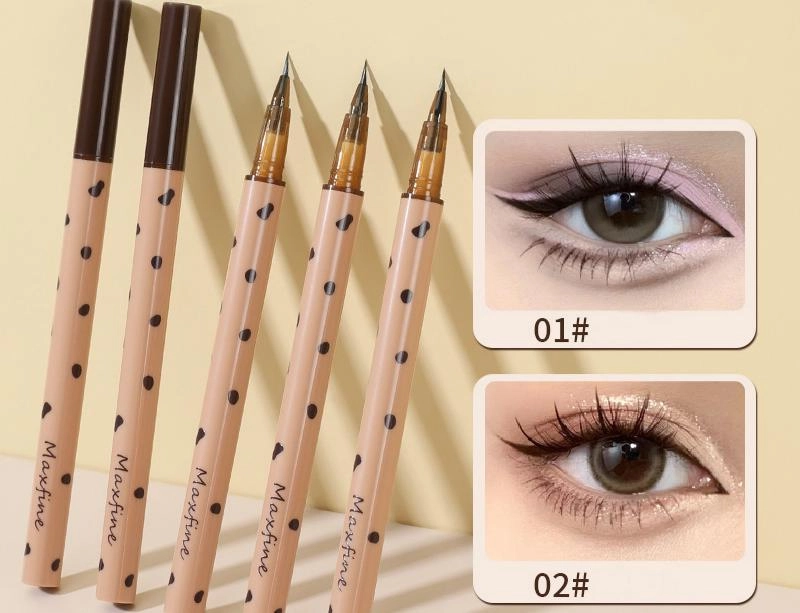
Ask the supplier to identify the refill type, feed material, tip material, filling orientation, and target fill. The project records liquid pen components with a refill and gives a 0.5 mL liquid side for a double-ended brow format. That volume is not a rule for every eye pen. It is a useful reminder that reservoir design and fill are explicit component decisions that must be confirmed on the proposed eyeliner sample.
Run repeated strokes after the pen has rested tip-up and tip-down, where those storage positions match the intended pack. Add a short shake and a normal-cap opening test. Look for a pale first line, an ink bead, skips, tip swelling, split ends, and a change in line weight. A standard felt tip may tolerate a little more pressure, while a fine brush tip may reward a lighter hand. That difference should be observed, not assumed.
Packaging can change the result. Check the cap seal, inner plug or wiper where present, barrel joint, leakage after handling, and whether the tip dries at the opening. If the formula or ink is adjusted after the tip is approved, repeat the flow test. A different solvent balance can change wetting and drying even when the outside pen looks identical.
Compare Set Time, Water Resistance, And Removal
A waterproof eyeliner claim is a balance rather than an unconditional promise. Film-forming ingredients may help a line resist water or sweat after it has set, but the pen still needs to feed smoothly and remove in a way that suits the target customer. A more resistant film may need an oil-based remover or more rubbing. A softer film may remove easily but transfer sooner in humid conditions. Define the trade-off before comparing samples.
Use A Test Matrix Instead Of One Splash Test
Check the wet line immediately, after the proposed set interval, after light water contact, after rubbing or blinking simulation, and during removal. Keep line thickness and drying time visible in the record. Do not describe a pen as waterproof because one thick mark survives a splash. A thin lash line can behave differently, and the eye area introduces movement, oil, and remover contact that a flat card does not reproduce.
It includes quick-drying, water-resistant, sweat-resistant, and anti-smudge directions across eye and brow formats. Those directions support a structured test plan, not a universal claim. For the waterproof liquid eyeliner route, confirm the application thickness, setting method, water or rub condition, removal product, and claim wording with the supplier before artwork approval.
A fine tip should also be judged on comfort and correction. If the tip catches on dry skin, the user may press harder and create a thicker line. If the ink sets too quickly, a beginner may be unable to adjust a wing. If it stays wet too long, the line may transfer to the upper lid. These are retail-use findings, not defects that can be predicted from tip diameter alone.
Approve The Tip In The Final Private Label Pen
The final approval file should name the tip construction, feed or refill, ink or formula revision, fill level, barrel, cap, seal, storage orientation if relevant, and test conditions. Compare 0.02 mm and standard felt samples with the same shade and intended application. Retain the approved pen and a written photo record of the line, flow, dry-down, water resistance, removal, and package condition.
An eyeliner manufacturer should also help identify where the design is tolerant and where it is not. A 0.02 mm tip may be the better choice for fine inner-corner detail, but it may demand tighter control of viscosity and feed. A standard felt tip may suit faster application and a wider retail audience, but it may not deliver the same narrow line. Neither format wins without a clear consumer routine and a repeatable QC method.
Later in development, L&J Cosmetics can support eyeliner direction, component selection, packaging, printing, and sample review. The project brief should state the target line, intended user, waterproof or easy-removal balance, storage expectations, and claim boundary. That gives the development team a real product decision instead of a race to print the smallest number on the carton.
FAQ
Q1: Is a 0.02 mm eyeliner always more precise than a standard felt tip?
A1: No. Visible precision depends on tip structure, ink flow, pressure, angle, skin texture, and the user’s technique. Compare finished pens under the same stroke conditions.
Q2: Is 0.02 mm the same as L&J Cosmetics’ confirmed eyeliner specification?
A2: No. The project record confirms a 0.01 mm ultra-fine brush tip for a named product direction. A 0.02 mm target needs its own component and line test.
Q3: What causes a fine tip eyeliner to skip?
A3: Possible contributors include slow feed replenishment, a dry or damaged tip, formula wetting problems, insufficient shake, low fill, or an application angle that interrupts contact. Test the system together.
Q4: Can waterproof eyeliner also be easy to remove?
A4: It can be designed toward that balance, but the result depends on the film, set time, remover, rubbing, and use conditions. Both wear and removal need approval testing.
Q5: What should a private label buyer approve before eyeliner production?
A5: Approve the tip, feed, formula, fill, barrel, cap seal, line-flow method, set and water tests, removal guidance, artwork claim, and retained final-package sample.